Debt Snowball vs Avalanche: Which Pays Off Debt Faster?
When you have several debts, the order in which you pay them matters. The two most popular strategies are the debt snowball and the debt avalanche. Both work; they just optimize different things.
The common rules
Whatever method you choose:
- Keep paying the minimum on every debt (missing payments costs fees and credit score).
- Find an extra amount you can pay every month — even $100.
- Put all the extra money on one target debt until it is gone.
- When it is paid off, add its whole payment to the next target. The payment “rolls” and grows — that is the snowball.
Debt snowball: smallest balance first
Order your debts from the smallest balance to the largest, ignoring interest rates. You clear the first debt quickly, which gives you a visible win and keeps you motivated.
Best for: people who need momentum, or who have many small debts.
Debt avalanche: highest interest first
Order your debts from the highest interest rate to the lowest. Mathematically, this minimizes the interest you pay.
Best for: disciplined people with high-interest credit cards.
Example
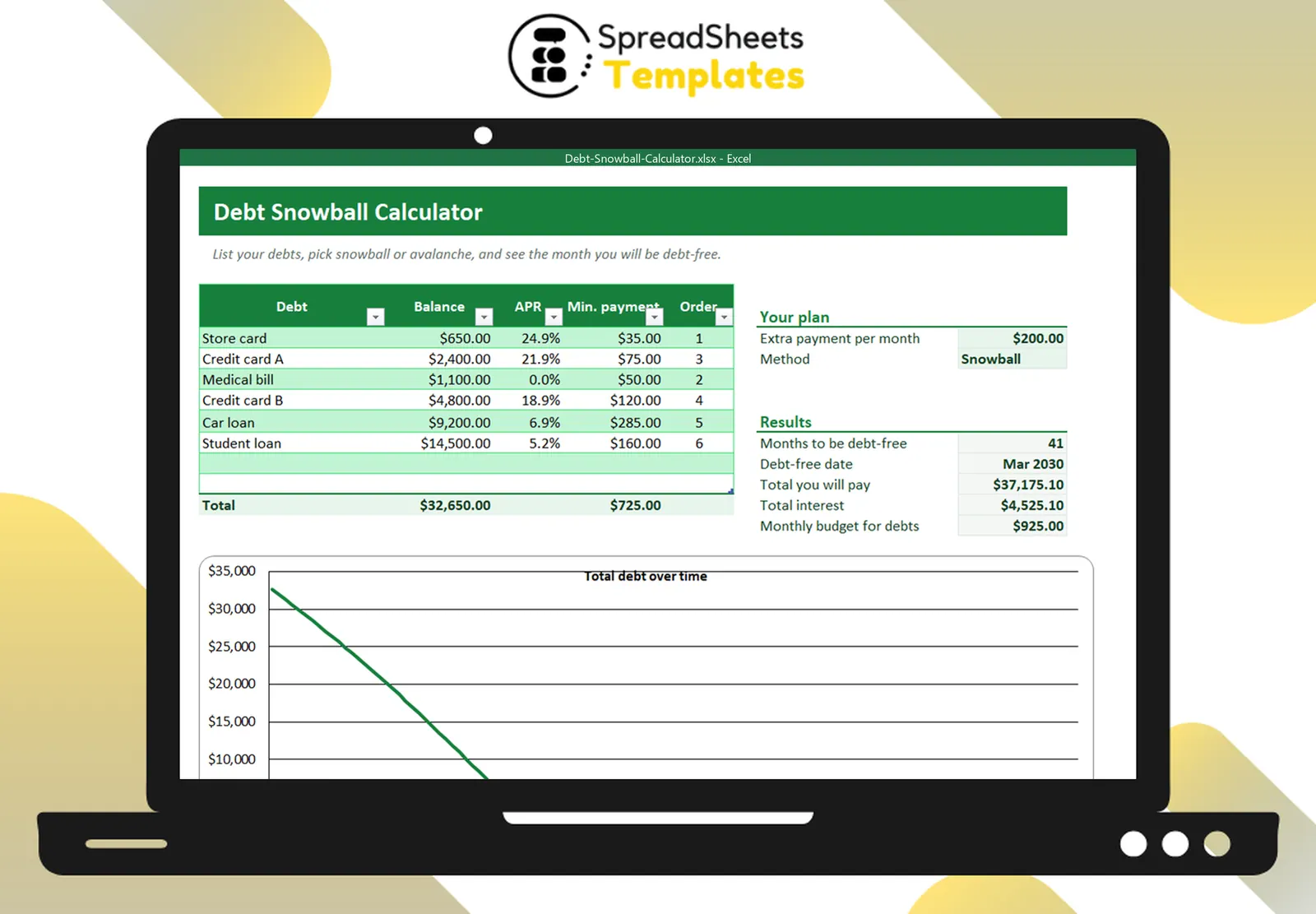
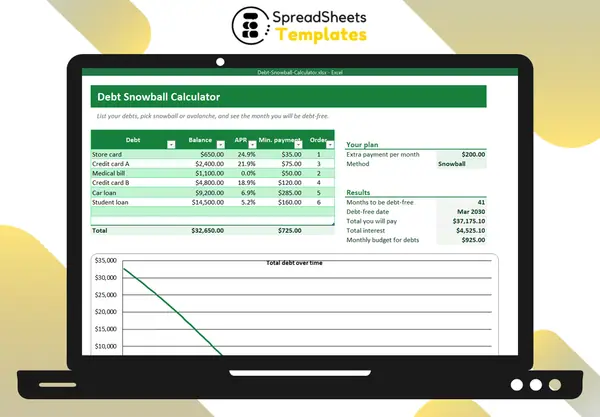
Imagine six debts totaling $32,650 with $725 of minimum payments and $200 extra per month:
| Debt | Balance | APR |
|---|---|---|
| Store card | $650 | 24.9% |
| Medical bill | $1,100 | 0% |
| Credit card A | $2,400 | 21.9% |
| Credit card B | $4,800 | 18.9% |
| Car loan | $9,200 | 6.9% |
| Student loan | $14,500 | 5.2% |
With $925 a month, both methods get this person out of debt in a bit over three years. The avalanche saves some interest because the cards go first; the snowball clears the store card and the medical bill in the first months, giving two quick wins. The difference in interest is often smaller than people expect — which is why many choose the method that keeps them going.
How to simulate it in Excel
A payoff plan needs, for every month and every debt: interest added to the balance, the minimum payment, the extra payment (only for the current target), and the new balance. The trick is the waterfall: the extra money goes to debt #1 in the order; whatever debt #1 doesn’t need goes to debt #2, and so on.
It is doable with formulas, but it takes a few dozen columns. The Debt Snowball Calculator already has it: list up to 8 debts, choose snowball or avalanche, type your extra payment, and it shows the payoff order, the debt-free date, the total interest and a month-by-month plan with a chart.
Tips that speed things up
- Stop adding new charges to the cards you are paying off.
- Send windfalls (tax refunds, bonuses, a third paycheck) to the target debt.
- Call your card issuer and ask for a lower APR — it works more often than you think.