Compound Interest Explained (With Excel Examples)
Compound interest is interest earned on interest. In the first years it looks slow; after a decade or two it does most of the work. Understanding it is the best argument for starting to save early.
Simple vs compound interest
- Simple interest: you earn interest only on the money you deposited. $1,000 at 7% earns $70 every year.
- Compound interest: each year’s interest is added to the balance, and next year you earn interest on the bigger balance. $1,000 at 7% becomes $1,070, then $1,144.90, then $1,225.04…
After 30 years, simple interest gives you $3,100. Compound interest gives you about $7,600.
The formula
For a single deposit: FV = P × (1 + r/n)^(n × t)
- P = initial deposit
- r = annual rate
- n = compounding periods per year (12 for monthly)
- t = years
In Excel: =P*(1+r/n)^(n*t) or simply =FV(r/n, n*t, 0, -P).
Adding monthly contributions
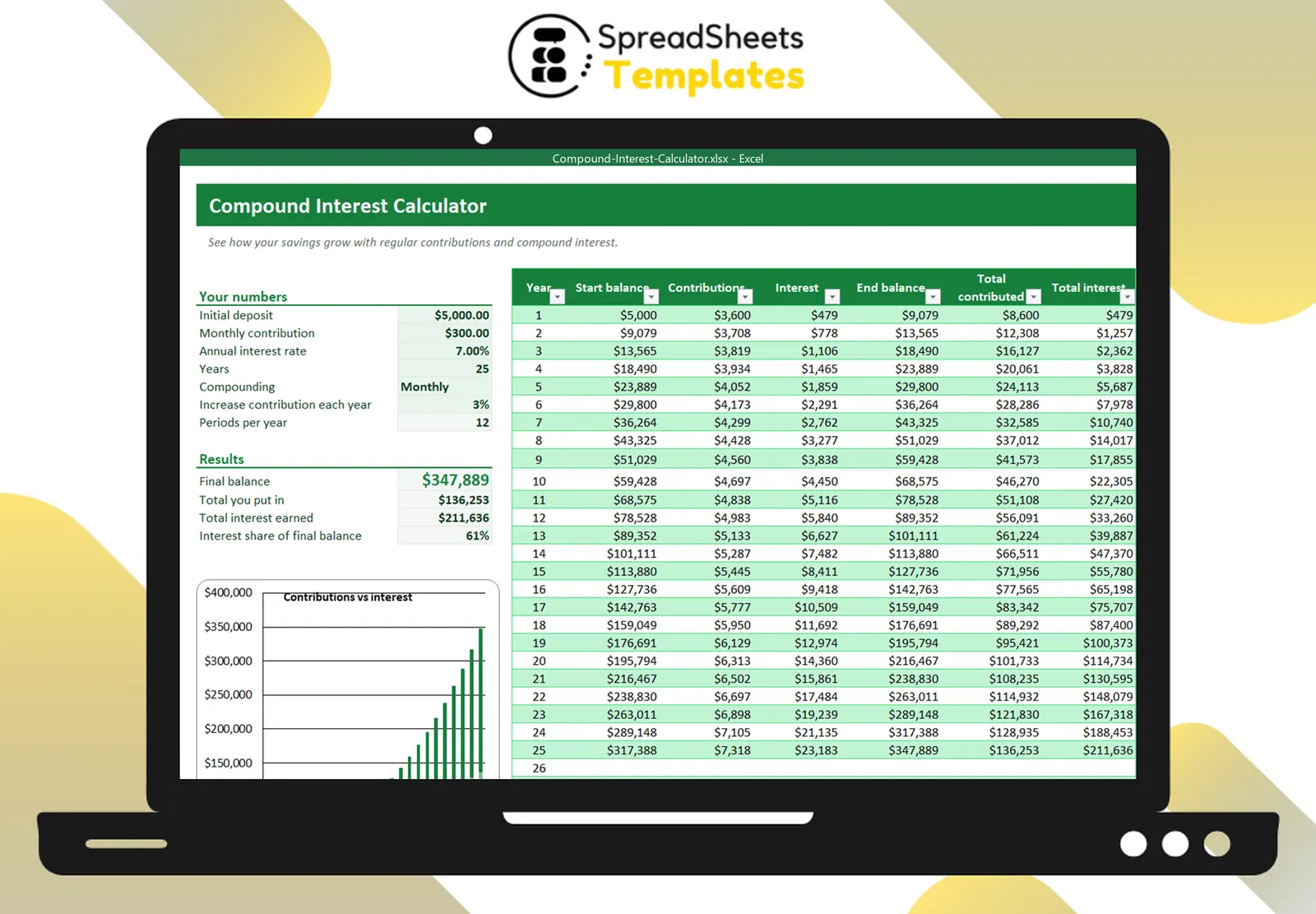
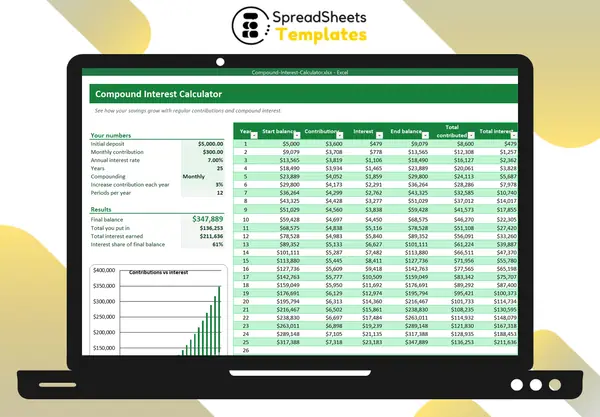
Regular contributions are where compounding gets powerful. With an initial $5,000, $300 a month and a 7% annual return compounded monthly:
| After | You contributed | Balance |
|---|---|---|
| 10 years | $41,000 | ~$62,000 |
| 20 years | $77,000 | ~$167,000 |
| 25 years | $95,000 | ~$271,000 |
By year 25, interest is more than half of the balance. If you also raise the contribution 3% a year (with your salary), the 25-year balance gets close to $350,000.
Excel can calculate the future value of contributions with: =FV(r/12, years*12, -monthly, -initial).
Three levers you control
- Time — starting 10 years earlier often matters more than contributing twice as much.
- Contribution — small increases each year add up.
- Rate — fees matter: a 1% fee on a 7% return removes a big slice of the final balance.
Be realistic about returns
No investment returns a fixed rate every year. Stocks go up and down; savings accounts pay less. For planning, use a conservative rate and consider inflation (a “real” return of 4–5% instead of 7–8%). This is a planning tool, not a promise.
Template
The Compound Interest Calculator lets you set the initial deposit, monthly contribution, rate, years, compounding frequency and a yearly contribution increase. It shows the final balance, how much is interest, a 50-year table and a stacked chart of contributions vs interest.