How to Make a Wedding Budget (With Typical Category Shares)
Weddings are made of dozens of decisions, and every one of them has a price. A clear wedding budget lets you spend on what matters most to you and say no to the rest without guilt.
Step 1: Set the total first
Before talking to any vendor, decide the total you can spend — from savings, monthly income until the date and any family contributions. Write it down. Every decision afterwards is “does this fit the total?”
Step 2: Decide the guest count
The guest list drives most of the cost: venue size, catering, rentals, invitations, favors. A useful number is the cost per guest: total budget ÷ guests. Cutting 20 guests often saves more than any other decision.
Step 3: Split the budget by category
Typical shares (they vary a lot by region and style):
| Category | Typical share |
|---|---|
| Venue | ~30% |
| Catering and cake | ~28% |
| Photography and video | ~10% |
| Attire | ~8% |
| Flowers | ~6% |
| Music | ~5% |
| Rings | ~3% |
| Decor | ~3% |
| Stationery, beauty, transport, favors | ~1–2% each |
Use them as a starting point, then move money to what you care about most.
Step 4: Keep a buffer
Set aside 5–10% for surprises: overtime fees, extra rentals, last-minute changes. If you don’t use it, it’s a honeymoon dinner.
Step 5: Track estimate, actual and paid
For every item, keep three numbers:
- Estimated — your plan;
- Actual — the signed price;
- Paid — deposits and payments made so far.
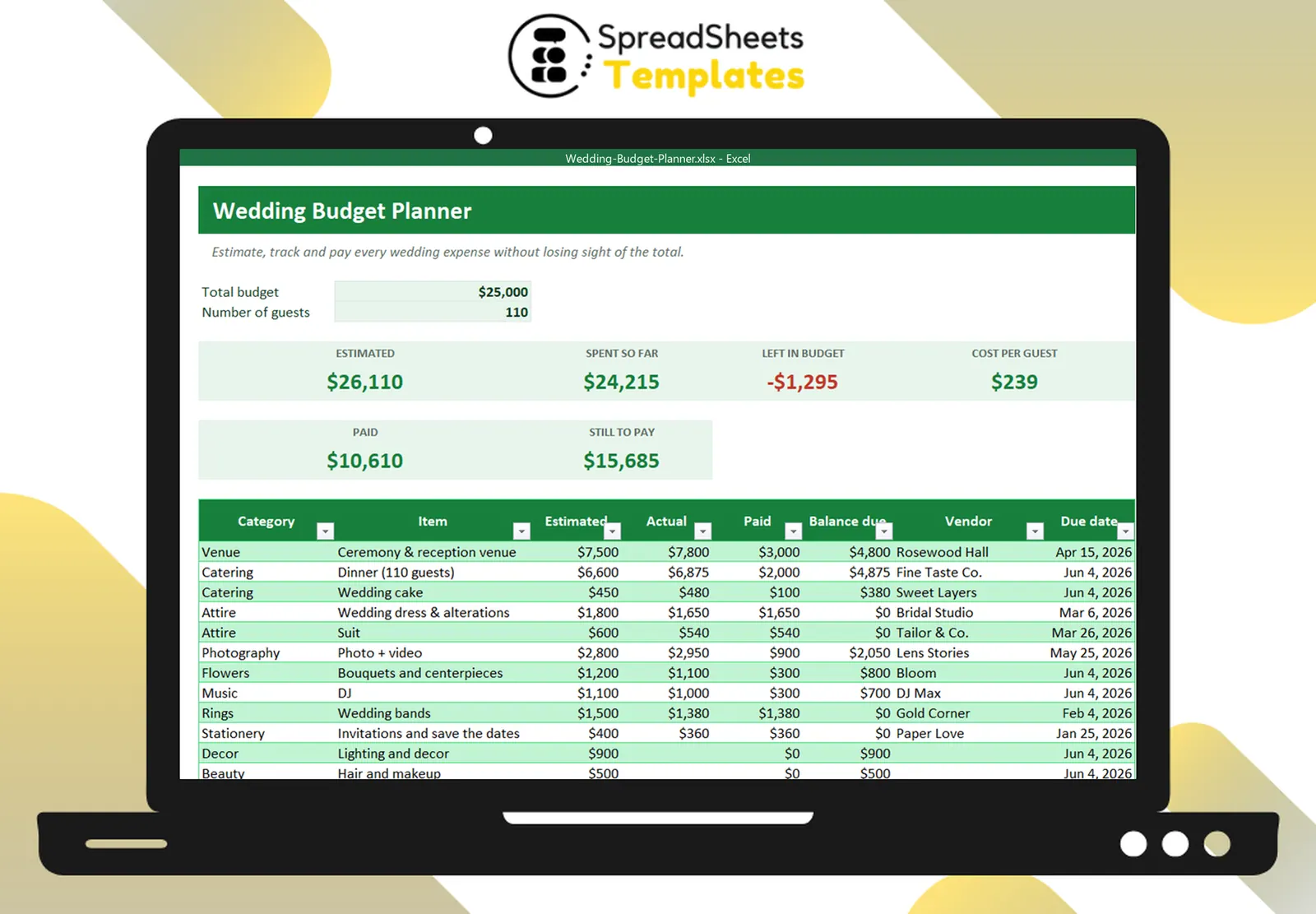
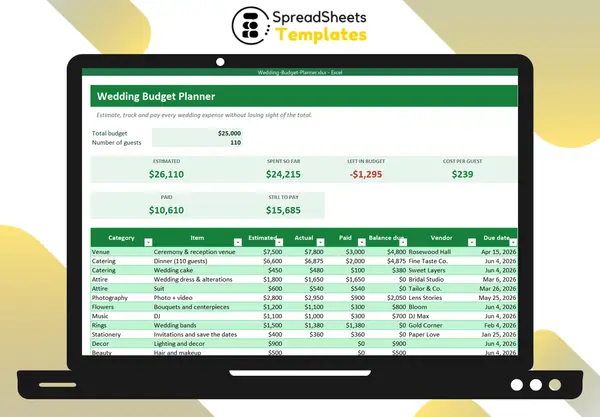
“Balance due” (actual − paid) tells you what you still owe each vendor. The money left in the budget should use the actual price when you know it and the estimate otherwise.
Step 6: Build a payment calendar
Venues and photographers ask for deposits months ahead and final payments close to the date. List every payment with its due date so the last month doesn’t become a cash crunch.
Template
The Wedding Budget Planner has all of this: total budget and guests, items by category with estimated, actual, paid and balance due, cards for what’s left and cost per guest, a comparison with typical category shares and a payment schedule.