What Is a RACI Matrix? Definition, Rules and Example
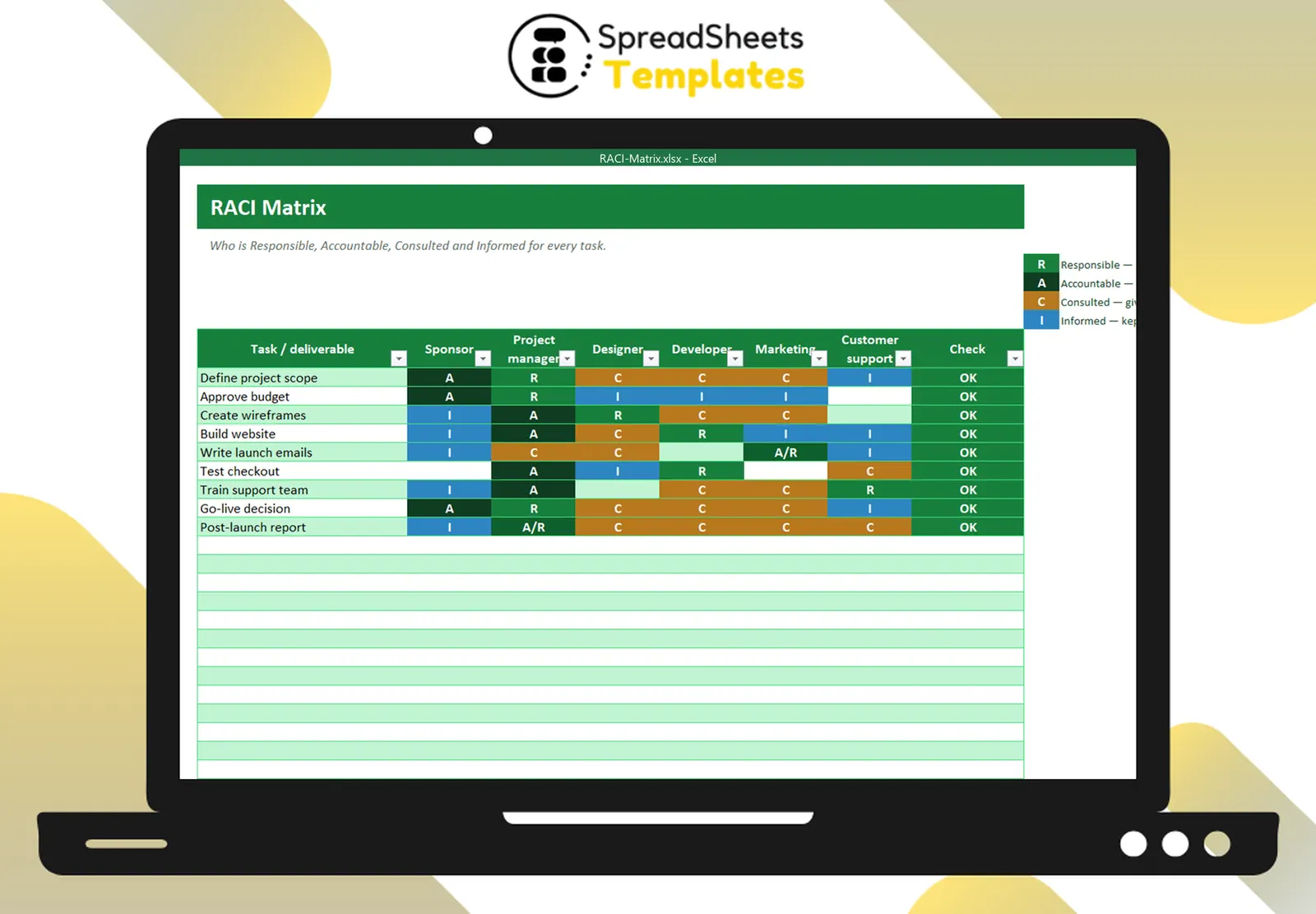
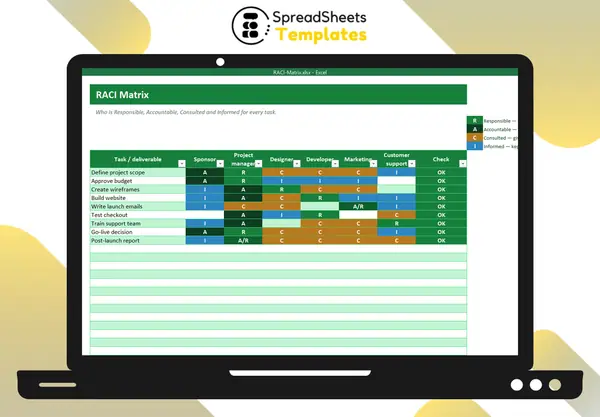
A RACI matrix (or responsibility assignment matrix) is a table with tasks in rows and roles in columns. Each cell says how a role is involved in a task. It prevents the two classic problems: work nobody owns and decisions everybody owns.
The four letters
- R — Responsible: does the work.
- A — Accountable: owns the result and signs off. Answerable if it goes wrong.
- C — Consulted: gives input before or during the work (two-way communication).
- I — Informed: kept up to date (one-way communication).
The golden rules
- Exactly one A per task. Two accountable people means nobody is.
- At least one R per task. Someone has to do it.
- Keep C small. Every consulted person slows things down.
- The A and R can be the same person (often written A/R).
Example
| Task | Sponsor | PM | Designer | Developer |
|---|---|---|---|---|
| Define scope | A | R | C | C |
| Wireframes | I | A | R | C |
| Build website | I | A | C | R |
| Go-live decision | A | R | C | C |
How to build one
- List the deliverables or key tasks (not every small action).
- List the roles (job titles work better than names).
- Fill in the letters with the team — the discussion itself is valuable.
- Check each row: one A, at least one R.
- Check each column: a role with many R’s may be overloaded; a role with many A’s may be a bottleneck.
When RACI helps most
New projects, cross-team work, client projects, process documentation and onboarding new team members.
Template
The RACI Matrix has drop-downs for R, A, C, I and A/R with colors, an automatic check for one A and at least one R per task, and workload counts per role.