How to Make a Balance Sheet for a Small Business
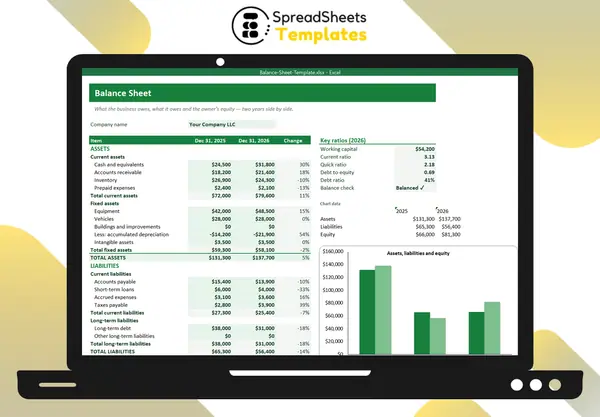
A balance sheet is a snapshot of your business on one date: what it owns, what it owes and what’s left for the owners. Banks ask for it, investors read it, and it tells you more about the health of a business than the bank balance does.
The equation
Assets = Liabilities + Equity
Everything the business owns was paid for either with borrowed money (liabilities) or the owners’ money and accumulated profits (equity). That’s why it always balances.
Assets
- Current assets (turn into cash within a year): cash, accounts receivable, inventory, prepaid expenses.
- Fixed assets: equipment, vehicles, buildings — minus accumulated depreciation.
- Intangible assets: software, trademarks, patents.
Liabilities
- Current liabilities (due within a year): accounts payable, short-term loans, accrued expenses, taxes payable.
- Long-term liabilities: loans and leases due after a year.
Equity
- Owner’s capital: money put into the business.
- Retained earnings: accumulated profits kept in the business (minus losses and owner draws).
Step by step
- Pick the date (usually the last day of the year or quarter).
- List bank balances, what customers owe you, inventory value and prepaid items.
- List equipment at cost and the depreciation accumulated so far.
- List what you owe: supplier bills, loan balances, taxes, credit cards.
- Add capital and retained earnings.
- Check that total assets = total liabilities + equity. If not, something is missing.
Ratios that matter
- Working capital = current assets − current liabilities (money to run day-to-day operations).
- Current ratio = current assets ÷ current liabilities. Above 1.5 is usually comfortable.
- Quick ratio = (current assets − inventory) ÷ current liabilities. Excludes inventory, which may be slow to sell.
- Debt to equity = total liabilities ÷ equity. Lower means less reliance on borrowing.
- Debt ratio = total liabilities ÷ total assets.
Healthy levels vary by industry; the trend from one year to the next is often more telling.
Compare two periods
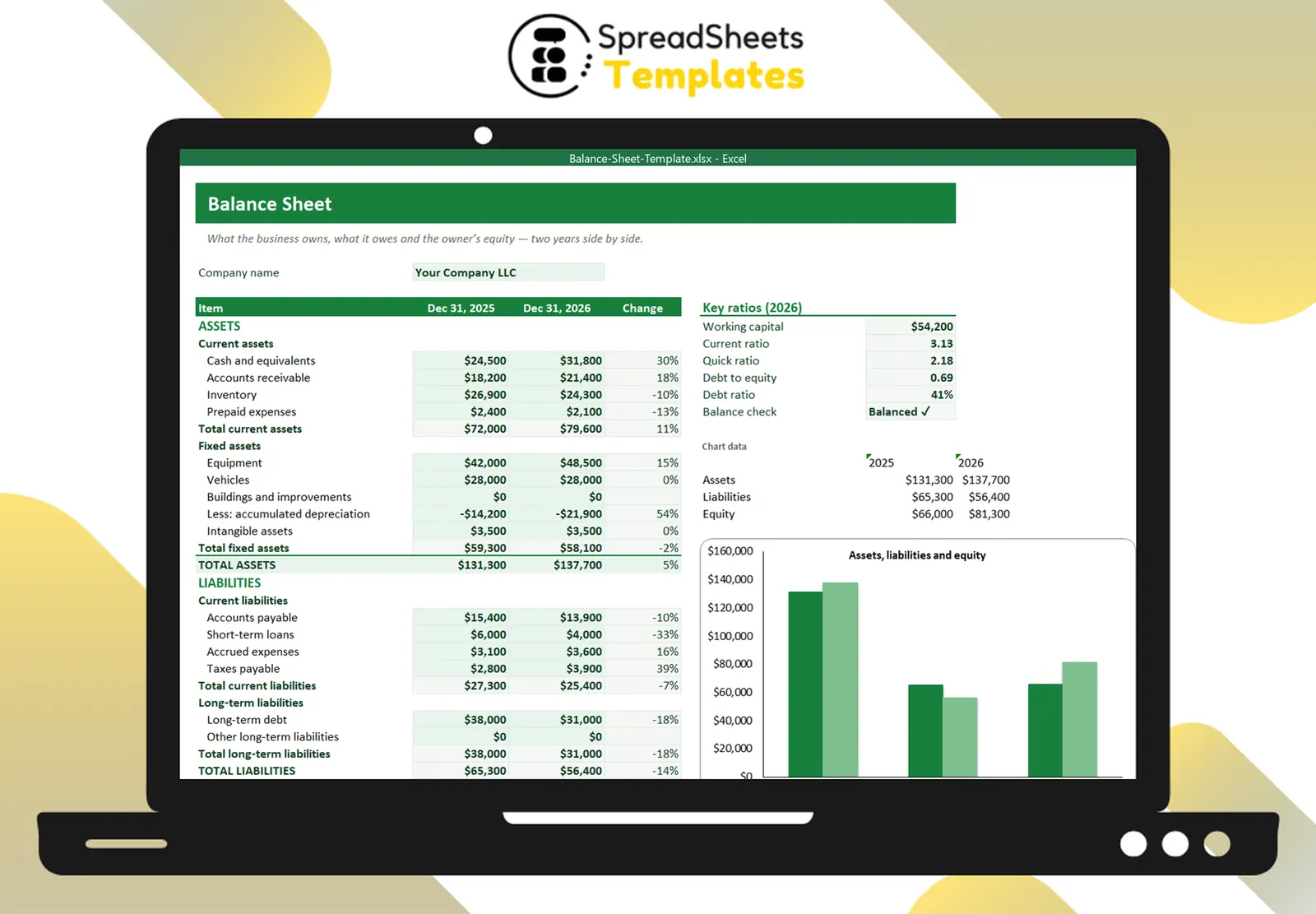
Putting this year next to last year, with the % change per line, shows whether you are building cash, collecting faster, carrying more inventory or taking on debt.
Template
The Balance Sheet Template has the standard structure for two years, % change, an automatic balance check, five key ratios and a chart. To build the numbers through the year, keep your transactions in Small Business Bookkeeping.