Vehicle Maintenance Log Spreadsheet: What to Track and How

A vehicle maintenance log is the cheapest insurance a fleet can have. Breakdowns rarely come out of nowhere: they come from an oil change that slipped by 5,000 km, a tire nobody rotated or a brake job postponed “until next month”. A simple spreadsheet that records every service and warns you before the next one is due prevents most of them.
What every maintenance entry should record
| Field | Why it matters |
|---|---|
| Date | Builds the service history and supports warranty claims |
| Vehicle (plate) | Always from a drop-down list, never typed |
| Odometer | The single most important field: intervals are measured in km/miles |
| Type: preventive or corrective | Shows whether you’re preventing problems or reacting to them |
| Service performed | Oil change, brakes, filters, alignment, suspension… |
| Parts replaced | Helps detect parts that fail too often |
| Supplier / workshop | Lets you compare price and quality between workshops |
| Cost (parts + labor) | Feeds cost per vehicle and cost per km |
| Next service odometer or date | The basis for alerts |
Preventive maintenance intervals
Always follow the manufacturer’s manual for each model. As a starting point, many fleets plan their schedule around intervals like these:
| Service | Typical interval |
|---|---|
| Engine oil and filter | Every 5,000–15,000 km (3,000–10,000 miles), depending on oil and use |
| Air and fuel filters | Every 2 to 3 oil changes |
| Tire rotation | Every 8,000–10,000 km (5,000–6,000 miles) |
| Brake inspection | At every oil change |
| Alignment and balancing | Every 10,000 km or when tires are replaced |
| Coolant, belts and hoses | Inspect at every service; replace as the manual specifies |
Heavy use (short trips, heavy loads, dusty roads) usually means shorter intervals.
How to build alerts in Excel
- In the maintenance log, add a column Next service (km):
=[@Odometer] + Interval. - In the vehicle register, find each vehicle’s latest planned service with
MAXIFS. - Compare it with the vehicle’s current odometer (the latest value from the fuel log).
- Apply conditional formatting: yellow when less than 1,000 km remain, red when overdue.
=MAXIFS(Maintenance[Next service km], Maintenance[Vehicle], [@Plate])
Do the same with dates for time-based items such as inspections, insurance and license renewals.
Don’t forget the tires
For trucks and vans, tires are one of the biggest costs after fuel. Give each tire an ID (or use its serial number) and log:
- vehicle and position (front left, rear right inner…)
- install date and odometer
- removal date, odometer and reason (wear, puncture, damage)
- retreads
With that, distance = removal odometer − install odometer tells you exactly how long each brand and position lasts, which is the data you need to negotiate with suppliers.
Reading the maintenance numbers
- Corrective share above ~30% of maintenance cost usually means preventive services are being skipped.
- The same corrective service repeating on one vehicle points to a root cause (driver behavior, a bad part or a bad workshop).
- Maintenance cost per km rising year after year is the clearest sign that a vehicle is approaching replacement.
Those indicators are covered in more depth in Fleet KPIs in an Excel dashboard.
Ready-made option
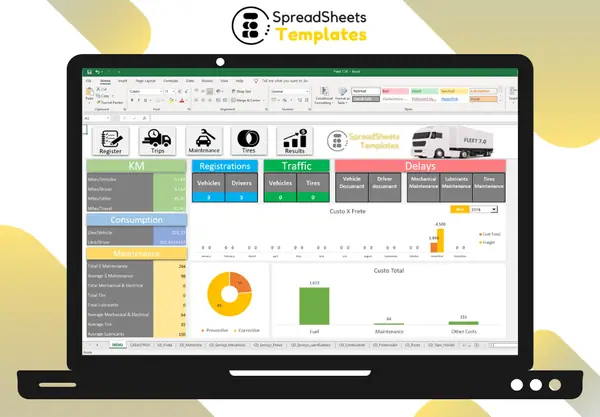
The Fleet Control Worksheet 7.0 includes preventive and corrective maintenance control, mechanical and electrical maintenance totals, tire control and dashboards with maintenance cost averages per vehicle, so you don’t have to build the formulas and alerts yourself. For the complete picture of running a fleet in Excel, see our fleet management spreadsheet guide.
FAQ
Is a paper logbook enough? Paper records the past but doesn’t warn you about the future. A spreadsheet calculates the next service and highlights what’s due.
Should I log maintenance by date or by mileage? Both. Most services are mileage-based, but vehicles that drive little still need time-based services (oil ages, rubber dries out).
How long should I keep maintenance records? For the whole life of the vehicle. A complete service history also increases resale value.