Fuel Consumption Tracking Spreadsheet: Calculate MPG, km/l and Cost per Mile
Fuel is usually the largest variable cost of any vehicle operation, and it’s also the easiest one to lose control of. A fuel consumption tracking spreadsheet shows you, trip by trip and vehicle by vehicle, how far each liter or gallon really goes and what every mile costs.
The full-tank method (the only reliable one)
Fuel gauges and partial fill-ups lie. To measure consumption accurately:
- Fill the tank completely and record the odometer.
- Drive normally.
- Fill the tank completely again and record the odometer and the amount added.
- Consumption = distance driven ÷ fuel added in the second fill-up.
If you add fuel in between (partial fill-ups), sum all the fuel added until the next full tank.
The formulas
| Metric | Formula |
|---|---|
| Distance | Odometer now − odometer at previous full tank |
| km per liter | Distance (km) ÷ liters added |
| Miles per gallon | Distance (miles) ÷ gallons added |
| Liters per 100 km | Liters ÷ distance (km) × 100 |
| Fuel cost per km/mile | Amount paid ÷ distance |
| Total cost per km/mile | (Fuel + tolls + fixed expenses) ÷ distance |
Example: a van drove 520 km between full tanks and took 65 liters at $1.30 per liter. Consumption = 520 ÷ 65 = 8 km/l. Fuel cost = 65 × 1.30 = $84.50, or $0.16 per km.
Columns for your fuel log
Date · Vehicle · Driver · Odometer · Liters (or gallons) · Price per unit · Total paid · Full tank? (yes/no) · Station · Notes
The “Full tank?” column is what allows correct calculations: compute consumption only on rows marked “yes”, summing any partial fill-ups since the previous full tank.
How to spot fuel waste
Once you have a few weeks of data, compare:
- Each vehicle against its own average. A sudden drop of 10% or more usually means a mechanical issue (tire pressure, injectors, air filter) or a change in route.
- Drivers on the same vehicle model. Big differences point to driving style: idling, aggressive acceleration, speeding.
- Fuel paid vs. distance driven. Fuel paid that doesn’t match the distance can indicate fuel card misuse.
Conditional formatting that highlights consumption below 90% of the vehicle’s average makes these cases jump out without any analysis effort.
From fuel to the real cost of a trip
Fuel alone doesn’t tell you whether a trip made money. Add tolls and fixed expenses (driver per diem, insurance share, financing) and divide by the distance to get the total cost per mile. That’s the number you need before quoting the next load. To price freight before you accept it, see the Freight Calculator Spreadsheet.
A template that does the math
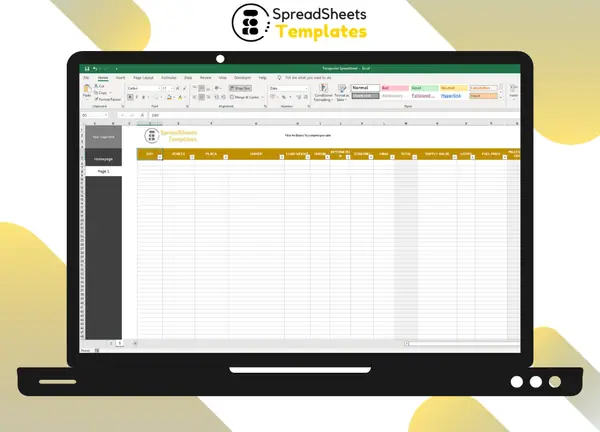
Our Transporter Spreadsheet logs each trip with vehicle, plate, driver, load, origin and destination, fuel paid, liters and price, tolls and fixed expenses, and calculates distance, miles per liter, total expenses and expense per mile automatically, with formulas ready for nearly 1,000 trips. For full fleet control (maintenance, tires, dashboards), see the fleet management spreadsheet guide.
FAQ
Should I track fuel per trip or per fill-up? Per full-tank cycle for consumption, and per trip for cost. A good log supports both.
What’s a normal fuel efficiency for my vehicles? The best benchmark is your own history per vehicle and route. Manufacturer figures are measured in ideal conditions.
Can I track several vehicles in one file?
Yes. Add a vehicle column and use AVERAGEIFS / SUMIFS to calculate results per vehicle.